The Hounslow Tragedy
Revelations in a world famous inquest
When I searched the newspaper articles for Theodore Garrett I came across a number of references to the Hounslow
Tragedy. In many the surname was used but in some they referred to F H Garrett and I wasn't sure that this was
the same person as Theodore.
Many newspaper articles have been poorly transcribed and it took a while to
confirm this was indeed Theodore Francis Garrett that was involved in the inquest.
This incident revealed a lot about Victorian professional pride and Theodore's private and public life.
It gave me a lot more information about his actions, attitudes and approach to life. The subsequent events
played out as a Victorian melodrama and became a world wide story, being published as far away as New Zealand
and the United States.
Theodore was a principal part of this and a key witness in the following inquest.
In 1882 Theodore was an assistant to two doctors in a surgery in Hounslow.
The practice had two doctors - Dr Michael Whitmarsh and Dr William Whitfield Edwardes. Dr Edwardes had recently
bought into the practice paying a sum of about 1700 pounds.
In December 1882 Dr Edwardes attended a married female patient named Rose Bignall.
Subsequently she accused Dr Edwardes of unwanted advances and stated that he had committed an indecent assault.
After the visit she sent a letter to Dr Edwardes telling him that she no longer needed his services and
described what had happened as disgusting and insulting. The Bignells communicated by letter with Dr Whitmarsh
demanding an apology from Dr Edwardes.
Dr Edwardes was devastated and felt that his reputation would be destroyed
even if the accusations were proved false.
Dr Edwardes the visited the Bignalls and returned with a letter
that retracted the accusations.
After this retraction Dr Edwardes decided to take legal action against Mrs
Bignell. He employed Mr Barber for this.
Dr Whitmarsh accompanied Dr Edwardes to Mr Barber's office. It seems
that at this point Dr Whitmarsh suggested that it would be better for Dr Edwardes to leave the practice and let
things blow over.
After more solicitors became involved Dr Whitmarsh offered Dr Edwardes 500 pounds to leave.
Considering he bought into the practice at 1700 pounds, to Dr Edwardes this must have looked like an impossible
choice. If he stayed, he feared prosecution and professional disgrace. If he left, he surrendered his practice
and a huge proportion of the money he had invested.
Theodore accompanied Edwardes home and it seems that
Edwardes wife felt that the 500 pounds was the safest course of action.
That night Edwardes committed suicide by taking prussic acid. Before he did that he left a letter which
contained various accusations and statements later used in the inquest.
When the funeral took place the reaction was immediate. Dr Edwardes had become extremely popular locally,
particularly among poorer patients and when he was buried, a crowd estimated in one contemporary report at
approximately 2,000 people attacked Dr Whitmarsh's house. Windows were smashed and property damaged. Dr
Whitmarsh's effigy was reportedly burned. The police advised him to leave because they could not guarantee his
safety. This is important when reading the subsequent inquest evidence. The atmosphere was not remotely neutral.
This is the point at which the press became involved and it was publicised world
wide.
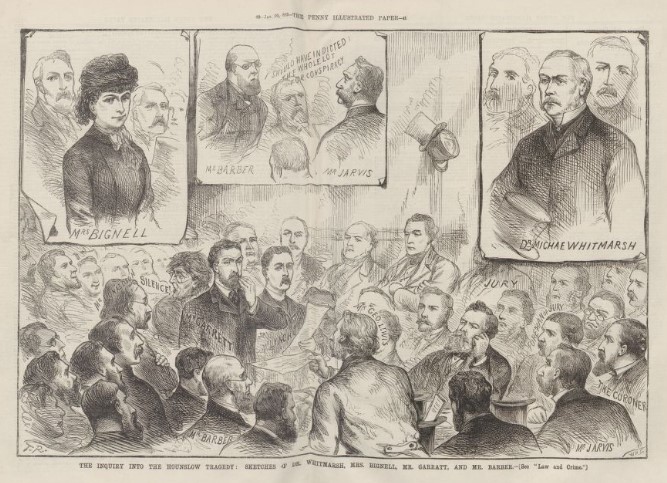
The inquest took place in January 1883 in Hounslow. Inquests at this time were more like modern day
trials and had a jury and legal representation for the two parties involved. No criminal conclusions could be
reached with an inquest, simply the reasons for death. However this played out in a different way and became
deeply personal. The principal lines of inquiry became:
1. Was Edwardes actually poisoned by his own hand?
2. Was he mentally responsible when he did it?
3. Was the Bignell allegation genuine?
4. Why did Bignell retract it?
5. What role had Whitmarsh played?
6. Why was Edwardes offered 500 pounds?
7. Was the threatened prosecution being used to force him out of the partnership?
8. Did Whitmarsh's conduct contribute to Edwardes's suicide?
Ada Edwardes
Edwardes's widow Ada Edwards was questioned about her husband's state of mind.
She said he had been deeply depressed about the practice and believed that he had been badly deceived about its value.
She confirmed that he had told her about the Bignell accusation only shortly before his death because he had initially wished to spare her distress.
She also confirmed the existence of Bignell's written retraction.
According to the newspaper report, she was asked whether Edwardes had been offered 500 pounds to retire.
She said yes.
She was then asked whether, after the retraction, he was threatened with proceedings unless he accepted the £500 and left.
Again, she answered yes.
Her testimony therefore strongly supported the Edwardes family's interpretation of events.
Theodore
Garrett was perhaps the most important witness after the widow.
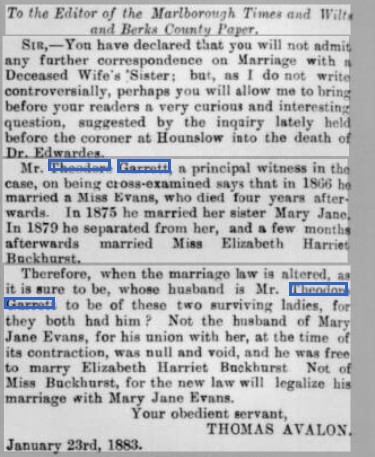
He had been present at several of the crucial conversations.
He testified that Whitmarsh had told him about the accusation.
He described the visit to the Bignells.
He described the retraction and he described subsequent conversations with Whitmarsh.
One particularly
damaging piece of evidence concerned Whitmarsh's reaction to the retraction. Garrett said Whitmarsh told him
that Bignell had signed the paper but had pushed it away and indicated that the allegation was nevertheless
true.
That would mean that Whitmarsh knew the retraction did not necessarily represent a genuine admission of
lying. Theodore Garrett also testified about the final negotiations and Edwardes's condition. But Theodore
himself was hardly an unimpeachable witness.
The contemporary reporting points out that he had falsely represented himself as a qualified medical man and
that his personal history - including several marriages - was subjected to embarrassing cross-examination.
The jury learns, in fairly rapid succession, that their important eyewitness:
1. was an unqualified medical assistant;
2. had represented himself as medically qualified when he wasn't;
3. had an extraordinary marital history;
4. had married his deceased wife's sister;
5. was giving evidence about his own employer and colleague;
6. had been present at the very meetings whose interpretation was at issue; and
7. was contradicted by Whitmarsh.
That is a devastating credibility profile and the particularly damaging thing is that Garrett's own answers
apparently supplied much of the ammunition. He didn't merely sit there while counsel accused him of things. He
admitted the false qualification and gave the rather extraordinary explanation about separating from his
deceased wife's sister 'on religious grounds'.
Whitmarsh
Whitmarsh eventually gave evidence under intense scrutiny.
He denied the interpretation being placed upon his actions. His position was essentially that:
- the accusation was serious;
- he had a responsibility to deal with it;
- he did not know that Edwardes would kill himself;
- the partnership dispute had its own background;
- and the 500 pounds arrangement was not the sinister conspiracy Edwardes's supporters claimed.
The cross-examination was extremely aggressive.
At one point Lewis effectively asked him whether he had been more concerned with Edwardes's reputation or his own financial interests. Whitmarsh declined to answer.
Then came the confrontation over Garrett's account.
Whitmarsh's version of the crucial meeting differed from Garrett's in several respects.
Lewis pressed him to say if Garrett's version and Whitmarsh's version could not both be right, which was false?
Whitmarsh's answer was essentially: One of them must have been mistaken.
Lewis pressed the distinction between making a mistake and giving false evidence.
It was an extremely damaging moment rhetorically, whether or not it established deliberate dishonesty.
The verdict
After the evidence, the jury reached an unusually expansive verdict.
They found that William Whitfield Edwardes died from prussic acid administered by his own hand while temporarily insane.
But they went much further.
They expressed the opinion that he had been driven to his death by the pressure exerted by Whitmarsh, with the false charge of Mrs Rose Bignell being used as a means of forcing Edwardes into an improper dissolution of the partnership.
This is extraordinarily important.
The coroner's jury was not merely saying 'suicide'.
It was effectively saying:
This was suicide along with temporary insanity and external causal pressure plus responsibility attributed to Whitmarsh and Bignell.
That is why the case became such a sensation. The verdict was not a criminal conviction of Whitmarsh or Bignell.
It seems from the newspaper article that the separation from Mary Jane was legally accepted but I can't find any divorce listed so it may be simply that it was socially accepted. I wonder what the legal situation would have been if Theodore had predeceased Mary and Elizabeth.
It also makes me wonder what happened to Dr Whitmarsh and if any legal action took place as a consequence.
By the end of the inquest I felt that I knew more about Theodore than ever before, yet understood him less.
He had admitted that he had no medical qualifications, yet had worked in a medical practice and been publicly described as a doctor. His complicated private life had been exposed in court, while his professional credibility had been attacked in front of a national audience.
And yet this was not the end of Theodore's story.
He somehow moved on from the Hounslow Tragedy and went on to build a new public career. How much damage had the inquest really done to him? How had he managed to retain, or perhaps rebuild, his reputation? And what had he learned from the extraordinary events of 1883?
I don't yet know the answers. But the Theodore who emerged from the Hounslow inquest was becoming a man I recognised: ambitious, unconventional and apparently determined to live his life on his own terms.
This left me with mixed feelings and curiousity as to how Theodore went on to navigate the borderline of respectibility and notoriety. But it continued to show that he lived life on his own terms.